Offline Meta-learning for Real-time Bandwidth Estimation
Using offline learning to dynamically select the best algorithm in real-time.
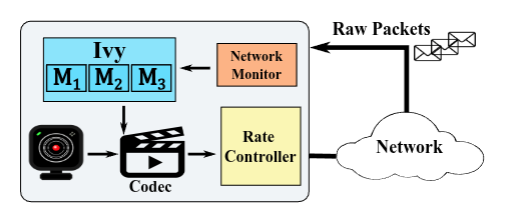
Fig. 1: Ivy's simple architecture: A lightweight neural network takes in real-time network data and selects the optimal bandwidth estimation (BWE) algorithm to use.
Problem & Motivation
Video call quality can be frustratingly inconsistent because network conditions change constantly—a phenomenon known as "data drift". A single bandwidth estimation (BWE) algorithm that works perfectly on a stable home WiFi might fail miserably on a fluctuating 5G connection. The industry's standard solution—periodically retraining a single model—is inefficient and often leads to "catastrophic forgetting," where improving performance for new conditions degrades performance for old ones. Furthermore, trying to learn new strategies during live calls is impractical, as it can actively harm the user's experience.
Our Approach & Contribution
Instead of searching for a single "one-size-fits-all" solution, we developed Ivy, a "metapolicy" that acts like an orchestrator for BWE algorithms. Ivy's job is not to estimate bandwidth itself, but to dynamically select the best-specialized algorithm for the immediate network conditions. We used a technique called offline meta-learning, training Ivy on a fixed dataset of video call telemetry without any live network interaction. Critically, Ivy is optimized directly for user Quality of Experience (QoE)—a measure of perceived call quality—rather than just raw network metrics, which don't always correlate with a better experience.
Results & Impact
Implemented in Microsoft Teams, Ivy demonstrated significant real-world benefits. It improved video MOS (QoE) by 5.9% to 11.2% compared to using any single BWE algorithm on its own. Its main value is preventing catastrophic failures; by intelligently switching algorithms, Ivy avoids the conditions that challenge any single algorithm, preventing quality drops that would otherwise occur. It also outperformed existing online selection methods in QoE by up to 11.4%. Lastly, Ivy proved to be far more data-efficient than traditional online learning, delivering up to 28% better QoE while using the same amount of training data.
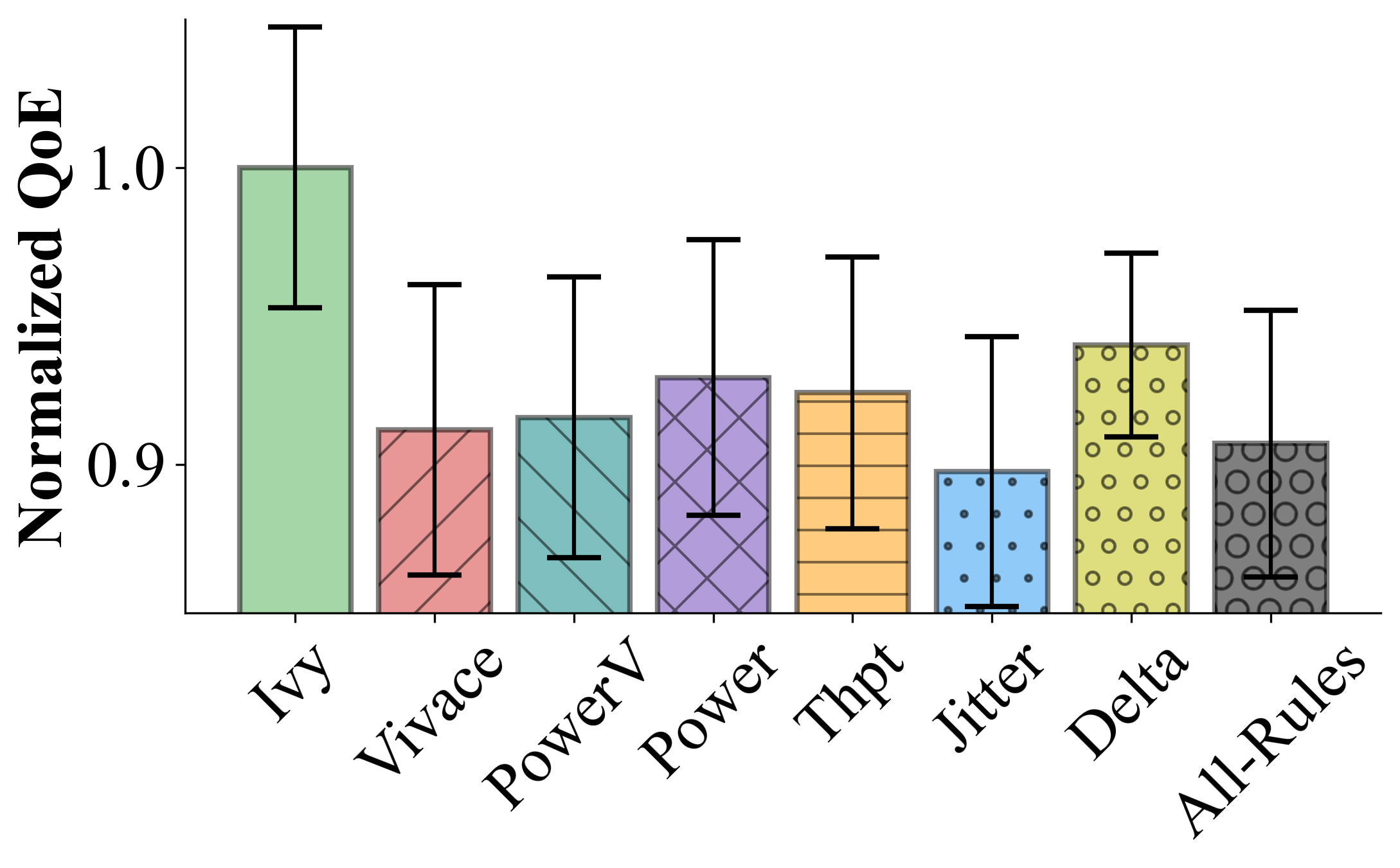
Fig. 2: Ivy's performance compared to online QoS-based heuristics in high bandwidth networks. It succeeds by prioritizing user experience (QoE) over network metrics (QoS).
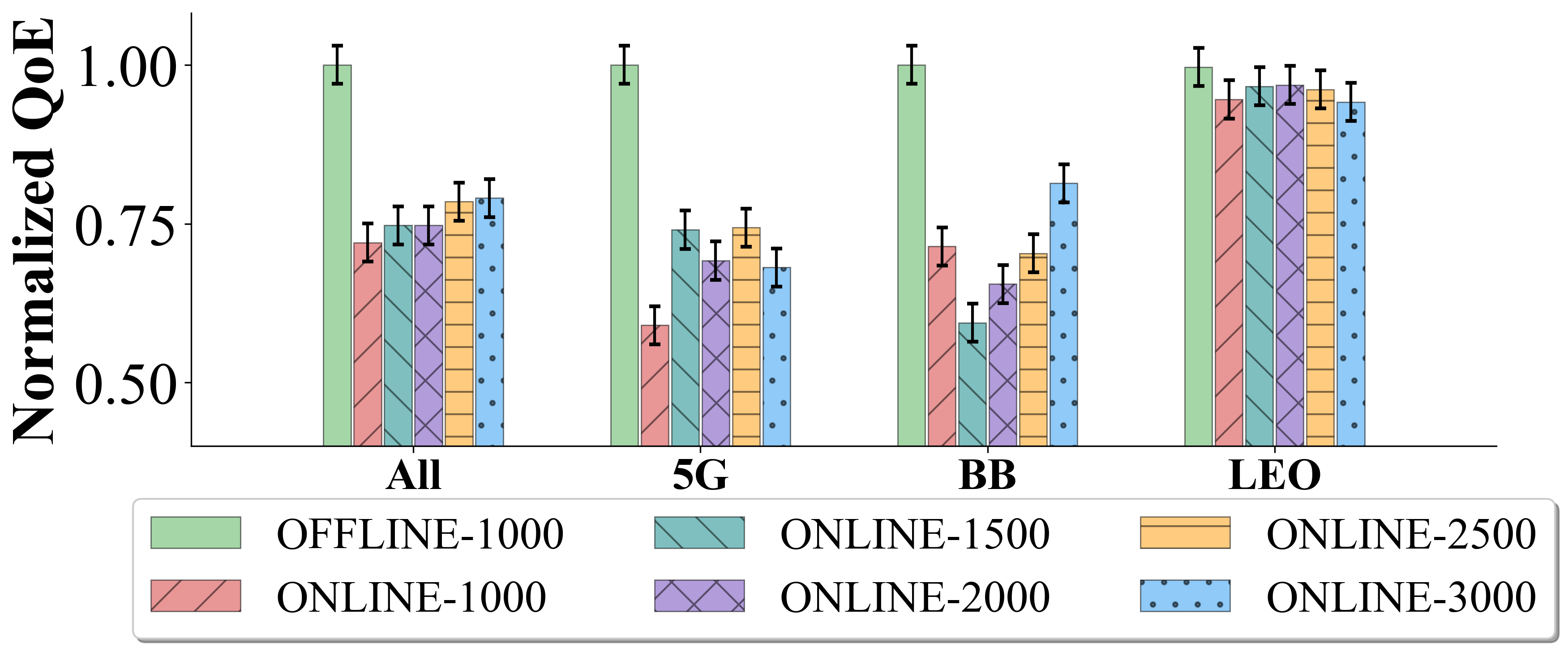
Fig. 3: Ivy's offline learning approach is far more data-efficient, achieving ~28% higher QoE than online models trained on the same 1000 call logs.